

International express delivery plays an important role in the global supply chain. However, barriers related to procedures, freight charges, and customs clearance are often very complex. In this article, PTN Logistics will provide detailed guidance on the process, document checklists, and pricing calculations. This will help businesses proactively plan their shipments more effectively.
What types of goods are suitable for international express delivery?
In import-export operations, choosing the appropriate transportation method for each type of cargo helps optimize costs and time.
Documents and paperwork
In international trade, documents such as bills of lading (B/L), certificates of origin (C/O), and commercial contracts play an important role in the delivery process. International express delivery services help businesses send documents to their partners conveniently and quickly.
With a transparent tracking system, businesses can proactively check the shipment’s journey and delivery time, ensuring that documents reach the right place at the right time.
Product samples
Product samples help businesses introduce their products, send samples to partners for quality inspection before signing contracts, or evaluate potential cooperation opportunities. For samples that need to be sent overseas, international express delivery helps shorten transportation time and facilitates convenient delivery.
The international delivery network enables businesses to send product samples to partners in many countries, making it easier to exchange information and evaluate products.
Shipments requiring delivery within a short time
In urgent logistics supply chain situations, time is a decisive factor. These may include machine components that need urgent replacement to maintain production lines, medical supplies, or products with short life cycles.
International express delivery services provide a priority flight network with the shortest possible transit time. This solution helps businesses promptly address any risks of disruption and maintain operational continuity.

Which types of goods require condition checks before shipping?
To ensure smooth customs clearance, certain categories of specialized goods must meet additional specialized inspection requirements:
- Food, cosmetics, and pharmaceuticals: These goods are subject to strict safety controls. When using international express delivery services, businesses need to prepare FDA certification (for the US market) or equivalent health permits to ensure transparent declarations and avoid storage risks.
- Electronic devices containing batteries: Computers, medical devices, and industrial machinery fall into categories requiring aviation safety controls. When sending express shipments overseas, you need to provide a Material Safety Data Sheet (MSDS) so that airlines can assess risks and ensure compliance with IATA standards.
- Biological products, wooden handicrafts, and agricultural products: These goods must be controlled to minimize the risk of spreading pathogens. Before entering the international delivery network, shipments must have a Phytosanitary Certificate or a Fumigation Certificate.
What information needs to be prepared when sending goods overseas?
To ensure smooth customs clearance and on-time delivery, preparing an accurate declaration document package is an extremely important step.
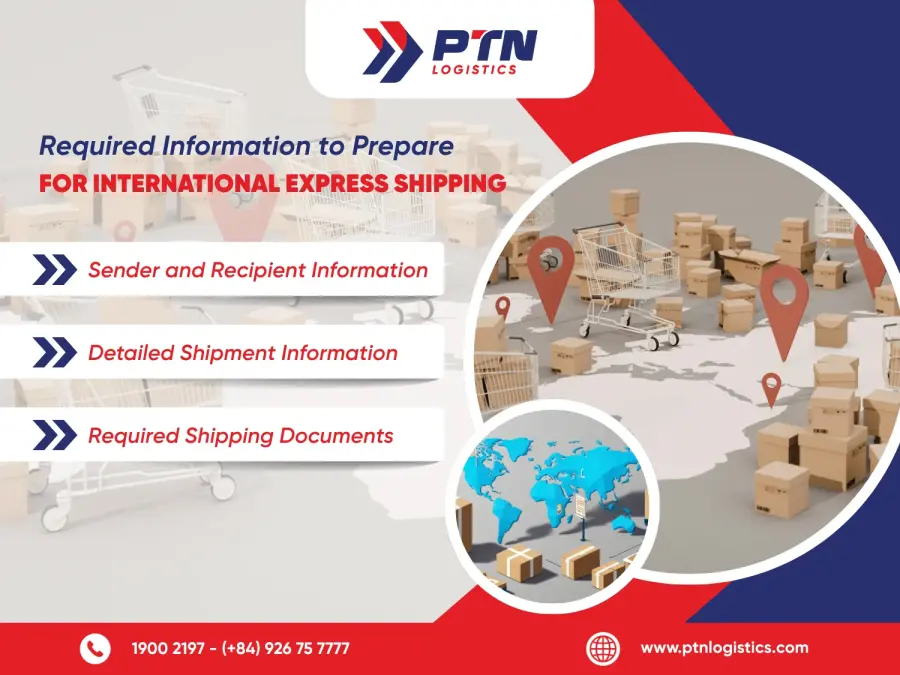
Sender and recipient information
The first step in the international express delivery process is to provide complete identification information. The sender must accurately declare the full names, detailed addresses, and contact phone numbers of both parties. This information helps the carrier create a valid Air Waybill. An incorrect postal code may cause a shipment to be routed incorrectly, resulting in storage fees or delivery delays compared with the original schedule.
Detailed information about the goods
To help the international express delivery provider arrange cargo capacity and facilitate customs declarations, you need to provide a shipment description with the following required specifications:
- Product characteristics: Product name in English, quantity, constituent materials, and HS code, if available.
- Measurement indicators: Three-dimensional measurements (length x width x height) and actual gross weight to serve as the basis for accurate freight calculations.
The more transparent the declared information, the easier it will be for your shipment to avoid the risk of being held for customs inspection at the border.
Accompanying documents
Depending on the characteristics of each product, international express delivery services will require the sender to prepare an export document package, including:
- Basic documents: Commercial Invoice clearly stating the value of the goods and Packing List.
- Specialized documents: Certificate of Origin (C/O), fumigation certificate, or Material Safety Data Sheet (MSDS), applicable specifically to regulated goods.
How does the international express delivery process work?
A standardized operating process helps optimize total transit time and minimize potential risks. Below are the four basic steps to ensure that shipments reach recipients safely.
Receiving and inspecting the goods
First, the delivery staff will pick up the goods from the business’s warehouse. The cargo is physically inspected to compare the quantity, weight, and dimensions against the declared information. Preliminary classification at this stage is very important in international express delivery services, as it helps determine whether the shipment contains prohibited items or goods requiring special handling before being loaded onto an aircraft.
Packaging and preparing documents
To ensure safety, shipments will be packaged according to IATA standards, using cardboard boxes, wooden crates, or pallets depending on their physical characteristics. At the same time, the international express delivery provider will assist businesses in reviewing and completing the customs documentation. Documents such as the Commercial Invoice and Packing List are prepared in advance, helping the export process proceed smoothly without interruption.
International transportation
After export customs clearance, the shipment will be loaded into the aircraft cargo compartment (Air Freight) for transportation to the destination country. When sending express shipments overseas, goods are usually routed through the airline’s transit hubs. The use of global positioning systems enables senders to easily track their shipments in real time, ensuring transparency throughout the journey.
Delivery in the destination country
When the aircraft lands, the goods proceed to the import customs clearance stage. After taxes and fees have been settled, the courier will carry out the final delivery stage (Last-mile delivery), bringing the shipment directly to the recipient (Door-to-Door). One advantage of international express delivery is that the system immediately updates the Proof of Delivery (POD) with an electronic signature, allowing businesses to confidently conclude the transportation process.

What factors affect international express delivery time?
The total transit time of a shipment is usually influenced by the following three main variables:
- Geographical distance and flight network: International express delivery speed is optimized through direct flights. Having to pass through multiple transit hubs or choosing a particular service package will determine connection waiting times and handling priority.
- Customs clearance procedures in the destination country: This is the factor most likely to cause time variations. If the declaration documents are incomplete or the HS code is incorrect, customs authorities may hold the goods for inspection, resulting in additional storage days.
- External factors: When sending express shipments overseas, schedules may be affected by bad weather, airport strikes, or congestion and warehouse overload during peak seasons.
Understanding these variables will help businesses become more proactive in predicting delivery schedules and managing supply chain risks.
How are overseas shipping costs calculated?
Understanding freight charges helps businesses proactively optimize their transportation budgets and avoid unexpected additional costs. Specifically, costs are determined based on two main factors:
- Chargeable weight: In international express delivery services, the carrier compares the actual weight (Gross Weight) with the volumetric weight (Volumetric Weight). The higher value will be used to calculate the freight charge based on the unit rate. The standard volumetric weight formula is: (Length x Width x Height in cm) / 5000.
- Base Rate & Surcharges: The total shipment cost includes not only the base rate but also additional surcharges. The most common include the Fuel Surcharge, remote area surcharge, and oversized cargo surcharge.
Providing accurate dimensions, weight, and destination information from the beginning is a solution that helps businesses proactively estimate costs.
How is international express delivery different from air freight?
Although both methods use flight networks, they serve different overseas shipping strategies depending on the scale and actual operational needs of businesses. To optimize your budget, you need to understand the fundamental differences between international express delivery services and traditional air freight through the comparison table below.
| Comparison criteria | Express Courier | Air Freight |
| Service coverage | Door-to-Door delivery. | Usually Airport-to-Airport. |
| Customs procedures | The carrier provides comprehensive support. | The cargo owner handles customs clearance or must hire a separate customs broker. |
| Cargo characteristics | Suitable for documents, small parcels, and samples (usually weighing under 100 kg). | Suitable for large-volume commercial goods and bulky cargo (usually over 100 kg). |
| Cost structure | Quotations are usually provided as an all-in rate. | Multiple charges are itemized: air freight, handling charges (THC), document fees (DO), and warehousing charges. |
| Shipment tracking | A Tracking Number provides detailed real-time tracking at each transit point. | Tracking is based on the Master Air Waybill between airports. |
International transportation becomes simpler when you understand the inspection requirements and standardized procedures. Do not let legal obstacles delay your business operations. Let PTN Logistics accompany you with a reliable, comprehensive service today!
Detailed Contact Information
- Hotline: 1900 2197 – 092 675 7777
- Email: nam.nguyen@ptnlogistics.com